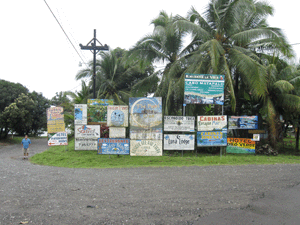
When entering Puerto Jimenez, one sees mini billboards advertising services for backpackers and eco-gurus
The first time I went to Puerto Jimenez was back in the mid 1970, and it took us about three days traveling on very pot-hole ridden, one-lane dirt road. And thinking back, I think we were heading to Panama or Golfito, made a right instead of going straight at Chacarita, and ended in this very remote town. About the only Gringos we saw were surfers who were headed to Cabo Matapalo, a small town that was becoming known for its awesome surf break. At the time it become most famous for its gold mining and logging in the 1960s. Even today, some try their luck at gold mining and these wood mills are still seen on the way.
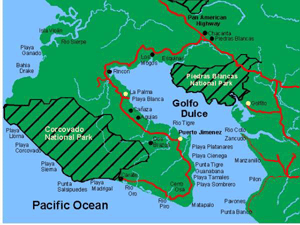
Named in honor of Costa Rican three-time elected President Ricardo Jiménez, Puerto Jimenez has grown to become the largest town on the Osa Peninsula that’s located in the southern part of the Puntarenas province and the threshold of Corcovado National Park. Read more... (742 words, 5 images, estimated 2:58 mins reading time)

Golfito, Costa Rica, has it all. Sportsfishing, ecotourism and culture
These days, the words Banana Republic are more likely to conjure up an image of neatly stacked chinos and v-neck sweaters than they are a place like Golfito. But when United Fruit built this town on the southwest coast of Costa Rica in 1939, there was nothing here but wilderness and Boruca, the region’s indigenous tribe. Fleeing a rash of banana disease. like what happened to Quepos, that was sweeping through their Atlantic coast plantations, United Fruit surveyed this deepwater bay sheltered within the Golfo Dulce and found untamed perfection. They built a massive dock, immaculate houses, schools, roads, a hospital-even a bowling alley-and they brought in workers from around the world. Most of all, they brought money and influence to a region that became their virtual fiefdom for nearly half a century.
That era ended a long time ago, with the last vestiges of Mama Chiquita (as United Fruit was called by its employees) pulling up stakes in the eighties. They left behind a company town without a company; Golfito is no longer immaculate but it is, once again, wonderfully Costa Rican. Read more... (1264 words, 2 images, estimated 5:03 mins reading time)

Mild earthquake hits outside of Golfito on late Saturday, early Sunday.
An mild to moderate earthquake estimated at 4.5 magnitude took place at 11:02:46, Saturday on 9.5.09 in Costa Rica.
According to the U.S. National Earthquake Center said the epicenter was about 5 miles east and north of Golfito in the southern end of the Puntarenas Region of Costa Rica.
This is the second earthquake to hit the southern zone. On March 11 of this year, one registered 6.3 on the Richter Scale, with an epicenter near Golfito as this one was.
The quake, which had a duration of about two minutes, was felt in San José and along the Pacific coast. Almost all the seismographs at Universidad Nacional’s Observatorio Vulcanológico y Sismológico de Costa Rica (UOVSCR) recorded the temblor.
According to one of my friends in the Golfito region, who emailed me this early morning, when she was awaken by it and that there was some minor damage at her house and one of her friends said, the store down the street, also had some minor damage.
Some products fell off of shelves and a some window cracking, she had a vase walk off the table. She did say, her shower head now leaks. Read more... (253 words, 1 image, estimated 1:01 mins reading time)

Coronado, Costa Rica - Is it the new hot spot for eco-tourism, development and wellness?
Not to be confused with the mountainous region north of San Jose, about half way between the Pacific side cities of Uvita (South of the Dominical) and Puerto Cortes, lies the growth-targeted natural wonderland of another, Coronado.
While tourist and retirees were flocking to Costa Rica’s northern Pacific Coast which has been perceived as the country’s first hot spot, further South (about 240 km from San Jose) on the Puntarenas province, and among the mist-shrouded mountains, cascading rivers, and vast tropical forests of the southern zone remained a secret that for years has been maintained by adventure-tourists, eco-gurus, and local Costa Ricans. It is warm and humid year round, average temperature: 83°. It’s rainiest season from May through October.
Needless to say, Costa Rican Government has anticipating the potential of this region first starting with President Oscar Arias who has finalized plans for a new international airport in the area that is to be built by 2010. Read more... (498 words, 2 images, estimated 1:60 mins reading time)

With a tide change of nine feet, Golfito is a quite town, Costa Rica's last frontier that is unmarred by the rat-race of city and tourist life.
The first time I heard of Golfito, I thought it was some golf resort - not a sport that many (if any at all) Costa Rican’s knew about.
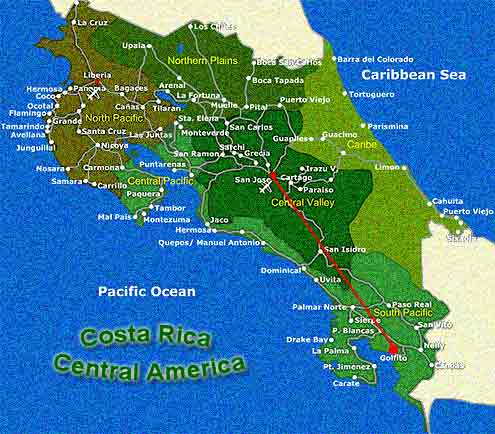
Golfito, literally meaning, “little bay” in Spanish, is referred to as the last frontier. It is considered a remote and secluded region of the country, Southern Pacific portion of the province of Puntarenas that’s separated from the open Pacific Coast by the famous Osa Peninsula of Costa Rica’s Golfo Dulce. It is about 360k from San Jose and about an hour plane ride in a 16 seater that lands on a single runway, flanked with tropical vegetation. A unexplored rugged wilderness, where the amenities are basic, but the where one can experience an alternative Costa Rica compared to the hustle and bustle of the more popular touristy destinations.

A short landing via airplane to Golfito. Tip: not uncommon for your baggage to be left behind, to be taken on the next flight if the plane is overloaded, so travel light Read more... (699 words, 3 images, estimated 2:48 mins reading time)